
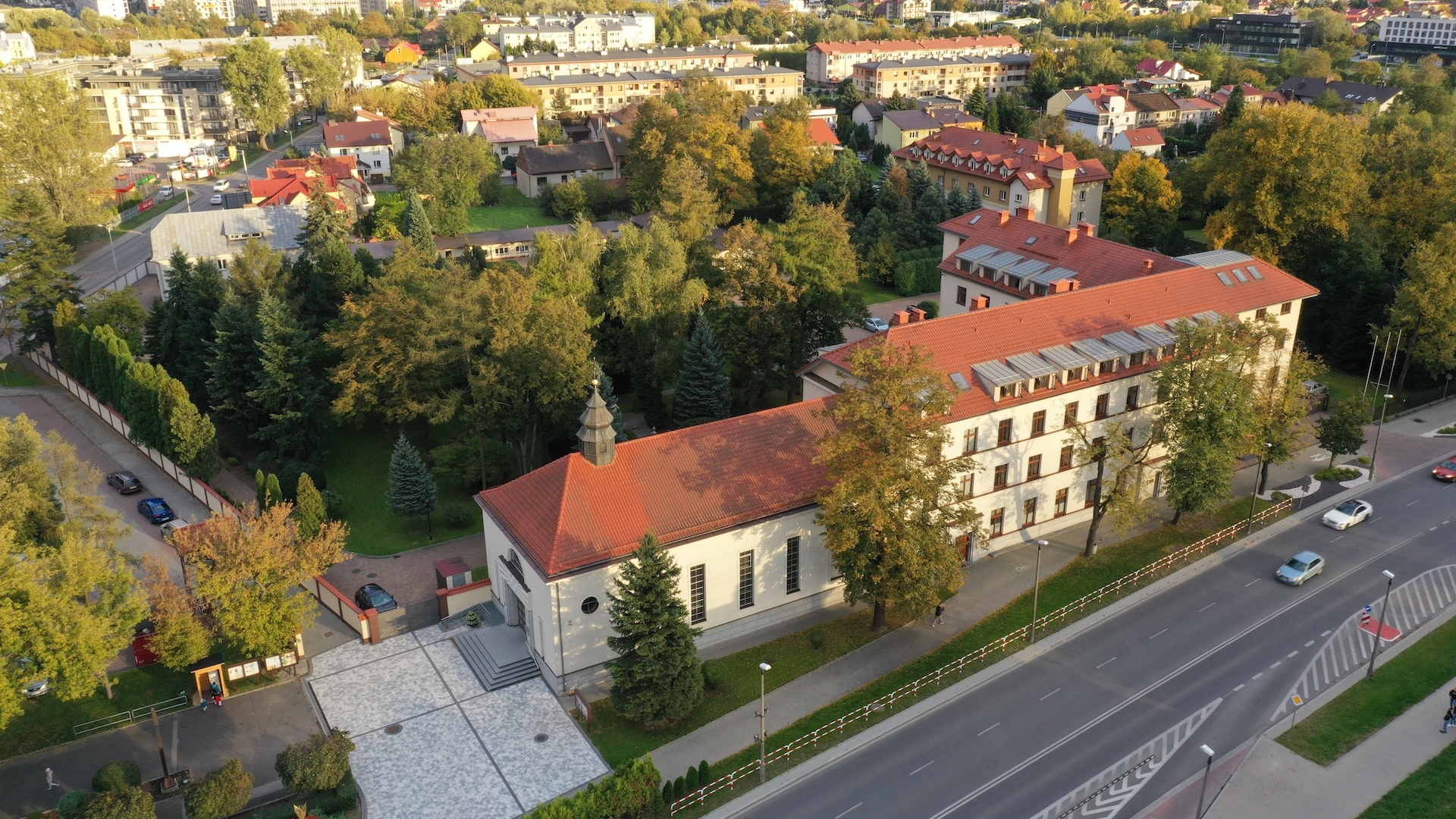
Our Lady of Płaszów
The Miraculous Image of Our Lady of Płaszów
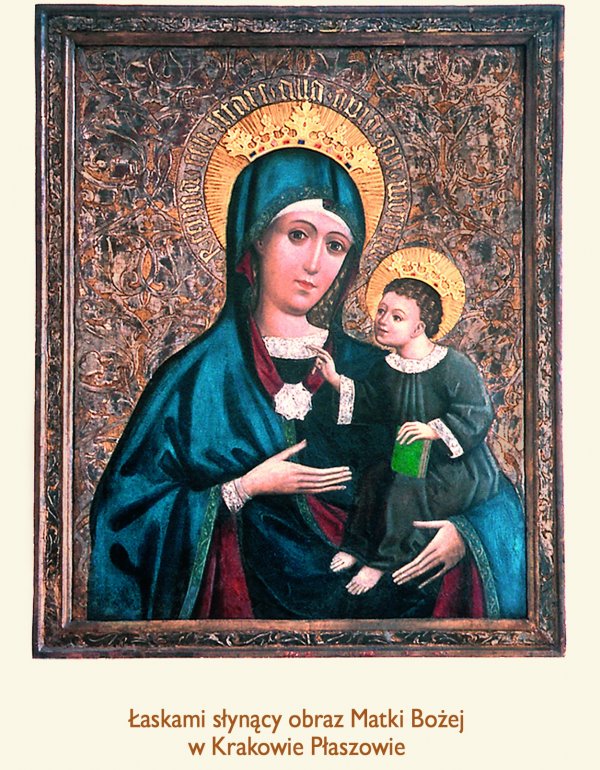
The image of Our Lady of Płaszów was created in the second half of the 15th century in the best-known and most widespread iconographic type, Hodegetria, depicting the Virgin Mary holding the Child Jesus (Hodegetria, from the Greek “she who shows the way”; “she who leads”). Mary points to Jesus Christ, serving as a signpost and showing us the right path. The image of Our Lady of Częstochowa, known to all Poles and venerated at the Jasna Góra Sanctuary, is also an example of Hodegetria, as is the image of Our Lady of Piekary from Piekary Śląskie. All these images share features found in every Hodegetria. Each has its own remarkable history, worth exploring further.
The image of Our Lady of Płaszów was painted by masters of the Sącz–Kraków school on a limewood panel prepared with chalk ground. The entire image, including the frame, measures 117 cm x 95 cm. Until 1850 it was in the parish church in Czernichów, venerated as an image of Our Lady renowned for many graces. For unknown reasons, it was later placed in a church storeroom, from which it was bought by Mr Cichoń, a church caretaker, admirer of historic religious art and man of deep faith devoted to Marian worship. From then on, the image became an important place in the Cichoń family home, bringing the family together in prayer for three generations. When Mr Cichoń’s son Stanisław moved to Izdebnik in 1900, his father gave him the image as a family keepsake. In 1929–1931 it underwent its first restoration, carried out by his son Władysław Cichoń, a graduate of the Kraków Academy of Fine Arts. The successful restoration saved the image
and gave it new life. Soon afterwards, at the request of his other son Marian and the family friend Wincenty Turek, both Sacred Heart seminarians, Mr Stanisław donated the image to the newly built Sacred Heart church in Płaszów. It was solemnly enthroned
in the church on 21 November 1931. Since then it has remained permanently in the Płaszów parish, where numerous graces obtained through the intercession of the Blessed Virgin Mary have been recorded.
In 1949 the image underwent another conservation attempt. Professor Wiesław Zarzycki undertook its restoration. During the work, the image was overpainted and significantly altered, except for the faces of the Virgin and Child. When Fr Wincenty Turek became parish priest in 1964, remembering the image from his childhood, he decided to restore its original appearance. He therefore contacted the conservation workshop at Wawel, which undertook another restoration. The conservation work lasted exceptionally long and ended in early May 1969. On 11 May that year the image returned to its place in the church; the ceremony was presided over by Bishop Jan Pietraszko.
It is remarkable that, despite the image’s long history and many vicissitudes, during which it suffered considerable damage and repeated restorations, the Madonna’s face has remained virtually unchanged – it was not destroyed and, apart from minor retouching, was not overpainted. In simple human terms, one might call this a true miracle. Perhaps Mary wishes to tell us something through it? As if she were saying: I am always the same, unchanging, and for centuries I have called to you with all my heart; I am with you and wait for you.
In 1960 the Novena to Our Lady of Perpetual Help was introduced and later replaced by the Novena to Our Lady of Płaszów. Since that year, a second parish indulgence feast has also been held in honour of the Motherhood of Our Lady, on 11 October or the first Sunday after that date. The initiative came from Kraków auxiliary bishop Fr Karol Wojtyła, who presided over the first celebration on 16 October 1960. Cardinal Wojtyła saw in the history of this grace-giving image a miraculous parallel: it was first in a church, then for three generations in an ordinary family home, before returning to the church with human experience.
Numerous testimonies show that, before the miraculous image of Our Lady of Płaszów, graces are sought for family, married and maternal life. Many couples pray for the longed-for gift of children. The faithful testify to graces received, thanking Our Lady of Płaszów for her care. In this light, Cardinal Karol Wojtyła’s earlier initiative to establish a feast in honour of the Motherhood of Our Lady was truly prophetic.
The solemn crowning of the image with episcopal crowns by Cardinal Franciszek Macharski, Metropolitan Archbishop of Kraków, was a very important event. The ceremony took place on 5 May 1991 in the presence of many residents of Kraków and the surrounding area.
On 23 October 1997, on the 50th anniversary of the establishment of the Sacred Heart Province in Poland, the Polish Sacred Heart Province and the Finland Region were entrusted to Our Lady of Płaszów. In 2013 the image underwent another restoration, carried out by a team of experts from the Kraków Academy of Fine Arts under Grzegorz Kostecki.
On 13 October 2019 the church was declared a diocesan sanctuary; the ceremony was presided over by Archbishop Marek Jędraszewski, Metropolitan Archbishop of Kraków.
| 4.5 / 5 Excellent based on 1508 reviews | |||
| Google 4.7 /5 | TripAdvisor 4.7 /5 | Booking.com 8.9 /10 | Hotels.com 8.8 /10 |

Twin
- Room area: 14 m2
- Max. occupancy: 1
FAMILY APARTMENT
- Room area: 33 m2
- Max. occupancy: 2
SUPERIOR SUITE
- Room area: 33 m2
- Max. occupancy: 2
Dwa pokoje TWIN dla rodzin
- Room area: 28 m2
- Max. occupancy: 4
DOUBLE
- Room area: 15 m2
- Max. occupancy: 2